You can use databases for years and never picture what happens between INSERT and the platter. I got tired of the black box, so I wrote one. bad-db is a small storage engine in plain Java — its own on-disk format, a B-Tree index I implemented node-split and all, tombstones, compaction, and a tiny query language on top. It’s named honestly. But every layer is one I now understand because I had to build it.
A file is not a data structure
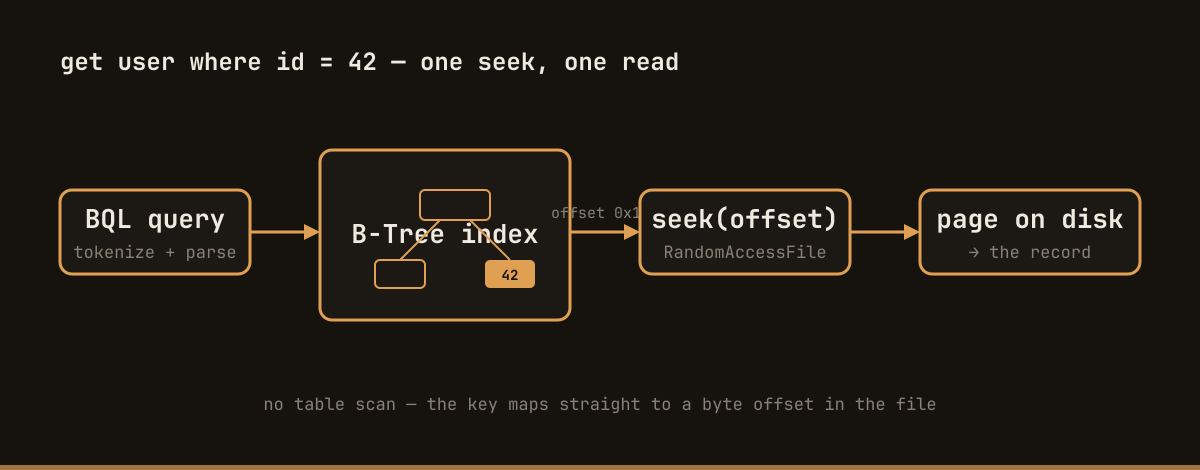
The first realization: a database file is just bytes, and you impose the meaning. bad-db stores records in a single file addressed by byte offset through Java’s RandomAccessFile. Writing a record means serializing it, appending it, and remembering where it went. Reading it means seeking to that offset. No magic — just an agreement about layout that both the writer and reader honor.
// bad-db's actual read path: look the key up, get an offset, seek, read (Table.java)
public Record searchByPrimaryKey(int key) throws IOException {
    Long offset = index.search(key);
    return offset == null ? null : fileManager.readRecord(offset, schema);
}
The moment you have “records live at offsets,” the real question appears: given a primary key, how do you find its offset without reading the whole file?
Why a B-Tree, and not the easy things
The lazy answer is a scan — read everything, check each key. That’s O(n) per lookup and dies the instant the file is big. The next lazy answer is a hash map from key to offset. Fast for point lookups, but it can’t do ranges (id between 40 and 60) and it has to fit in memory or spill awkwardly.
A B-Tree is the answer real databases reach for because it does both: logarithmic point lookups and ordered traversal for ranges, with a shape that stays shallow and balanced no matter what order keys arrive in. bad-db keeps a B-Tree mapping each primary key to its file offset.
The part that teaches you: splitting
Insertion is where a B-Tree earns its balance, and where I learned the most. The invariant is that a node holds at most 2t − 1 keys. You never insert into a full node — you split it first, pushing its median key up to the parent, so growth happens at the root and the tree stays balanced by construction.
// bad-db's real splitChild — the upper half and the median leave the full node (BTreeNode.java)
public void splitChild(int i, BTreeNode y) {
    BTreeNode z = new BTreeNode(y.t, y.leaf);
    for (int j = 0; j < t - 1; j++) {        // upper t-1 keys (and their offsets) -> new sibling z
        z.keys.add(y.keys.remove(t));
        z.values.add(y.values.remove(t));
    }
    if (!y.leaf) {                            // and their children too, if this isn't a leaf
        for (int j = 0; j < t; j++) z.children.add(y.children.remove(t));
    }
    children.add(i + 1, z);
    keys.add(i, y.keys.remove(t - 1));        // the median key rises into this (parent) node
    values.add(i, y.values.remove(t - 1));
}
The mirror of this is insertNonFull, which only ever descends into children it has already guaranteed aren’t full. Get these two right and the tree is balanced for free — get them subtly wrong and you get a corrupted index that reads fine until, one insert later, it doesn’t.
Deletes that don’t rewrite the world
Deleting a record by actually removing its bytes would mean rewriting everything after it. So bad-db does what real engines do: it writes a tombstone — a marker that says “the record at this offset is dead.” Reads skip tombstoned records; the space is simply wasted for now.
That trades write cost for space, and the debt comes due eventually. Compaction is the collector: it walks the live records, copies them into a fresh file, and drops the tombstoned dead weight — then the index is rebuilt to point at the new offsets.
The index is a cache of the truth, not the truth. The file is authoritative; the B-Tree is a fast way to navigate it. So on every reopen, bad-db rebuilds the index by scanning the file once. It’s the honest, boring choice — and it means a corrupted index is never fatal, just slow to rebuild.
What separates a toy from a database
I’ll say the quiet part: bad-db is single-threaded and has no write-ahead log. If it crashes mid-write, a page can tear, and there’s no recovery pass to make it whole again. That gap is the line between a teaching engine and one you’d trust with data — durability under failure is most of what “a real database” actually means, and it’s the next rabbit hole.
But that’s exactly why it was worth building. You don’t feel the value of a WAL until you’ve written the engine that doesn’t have one and understood precisely what breaks.
The full engine, including the BQL parser and REPL, is the bad-db project (source on GitHub). Write one of these once and you’ll never read “the database persists your data” the same way again.
Kartik Jain
Backend engineer & security researcher in Mumbai. Available for security assessments, penetration testing, and backend/API builds.
Get in touch →